
General and sports aviation in Spain has experienced remarkable growth in recent decades, turning into a dynamic sector that attracts both enthusiasts and professionals alike. As a result, new challenges have arisen in terms of airspace safety and management.
ENAIRE, in collaboration with the Real Aeroclub de España (RACE), is installing 30 stations across Spain to help general and sports aviation pilots enhance their operational safety and become more visible to airspace management systems and their own operations.
Enrique Maurer, ENAIRE's CEO, notes that “This initiative is part of ENAIRE's firm commitment to supporting the development and promotion of general and sports aviation in Spain, enhancing pilot safety by increasing their visibility through these surveillance stations”.
This technology includes devices installed on aircraft and unmanned aerial systems that transmit information, as well as the supporting infrastructure that enables system interconnection and information transmission. In this way, the data generated by these systems can be presented to pilots and air traffic services visually, audibly, or both, providing information about nearby traffic to reduce the risk of mid-air collisions and other types of accidents.
These devices and applications will enhance situational awareness based on the concept of "conspicuity", improving the safety of these operations by sharing position information among the various users of these airspaces, in keeping with one of the objectives promoted by the European Aviation Safety Agency (EASA).
The aim is to promote initiatives to increase the levels of safety and efficiency in operations carried out by non-commercial and sports aviation operators.
Benefits
- Transitions from "See and avoid" to "See and be seen", complementing the pilot's visual task.
- It enables pilots to see other traffic and, in turn, to be seen by others, even when using only a mobile application (which transmits position via the internet).
- It is integrated into most navigation software, such as SkyDemon, Airnav, EasyVFR, Safesky, etc.
- It significantly improves flight safety by reducing the risk of mid-air collisions.
- It becomes essential with the rise of drones and U-Space, as it is the aircraft operator's responsibility to be electronically visible within U-Space airspace.
- It has a contained and affordable cost, which increases depending on the complexity and functionalities of the devices.
- It will enable a quicker response to emergencies by being visible from the ground.
Agreement
This initiative is part of the collaboration agreement signed in 2023 by the Ministry of Transport and Sustainable Mobility, through the air navigation manager ENAIRE, with the Real Aeroclub de España (RACE), the Asociación de Pilotos y Propietarios de Aeronaves de España (AOPA), the Asociación Española de Pilotos de Aeronaves Ligeras (AEPAL) and the Real Federación Aeronáutica Española (RFAE).
The agreement covers a four-year period for jointly developing training activities and promoting applications and technological systems that enhance situational awareness and safety in this sector of air transport. These applications will rely on new technologies that enable the collection and exchange of aeronautical information.
The Real Aeroclub de España and its associates will be responsible for the equipment, its maintenance, and its commissioning.
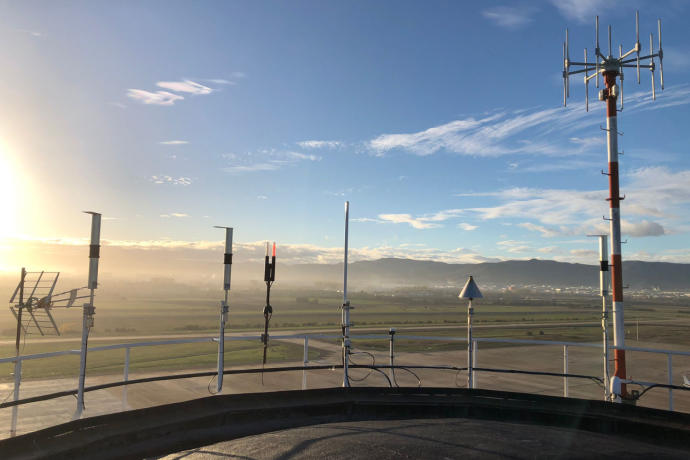
[One of the 30 stations installed by ENAIRE together with RACE that will help general and sports aviation pilots].
European regulations
The European Union Aviation Safety Agency (EASA) is spearheading the i-Conspicuity project, an initiative aimed at improving the interoperability of electronic conspicuity systems in general aviation.
The main objectives of the project include:
- Review of existing deployments: Analysing current digital solutions that provide pilots with situational traffic awareness in uncontrolled airspace.
- Interoperability: Identifying and analysing the requirements for interoperability among the main technologies used, considering different options for providing traffic situational data.
- Case studies: Evaluating the feasibility, limitations, and costs of the proposed interoperability requirements.
- Additional benefits: Assessing additional benefits for airspace users, such as the availability of additional data for search and rescue operations, safety event investigations, and training.
Implementing Regulation (EU) 2021/666 introduced a new provision into the Standardised European Rules of the Air (SERA), specifically SERA.6005, an article in Implementing Regulation (EU) 923/2012 that regulates requirements for transponders and radios in certain airspaces, such as transponder-mandatory zones.
It specifies the need to:
- Ensure operational safety by maintaining separation between aircraft and obstacles.
- Ensure compatibility between VFR (Visual Flight Rules) and IFR (Instrument Flight Rules) flights.
- Comply with the minimum visibility and altitude requirements to prevent accidents.
Acerca de ENAIRE
ENAIRE es el gestor nacional de la navegación aérea en España.
Como empresa del Ministerio de Transportes y Movilidad Sostenible, presta servicios de control de tránsito aéreo en las fases de Ruta y Aproximación de todos los vuelos con origen/destino nacional y sobrevuelos. Además, gestiona los servicios de comunicaciones, navegación y vigilancia de ENAIRE en el conjunto del espacio aéreo y en toda la red de aeropuertos de Aena en España y proporciona los servicios de control de tráfico aéreo de aeródromo en 21 aeropuertos, entre ellos los de mayor tráfico.
ENAIRE es el cuarto gestor europeo de tráfico aéreo y es miembro de las alianzas internacionales Alianza A6, SESAR Joint Undertaking, SESAR Deployment Manager, iTEC, CANSO y tiene una intensa colaboración con OACI.
ENAIRE ha obtenido la mayor calificación en el indicador clave de rendimiento en seguridad aérea a escala europea por cuatro anualidades consecutivas. Además, cuenta con el Sello EFQM 600 por su gestión segura, eficiente, innovadora y sostenible de los servicios de navegación aérea.